
The Thing About Gunter Sachs Is This:
He wasn’t rich. He was visibly rich. His most famous statement still is:
“You’re allowed to spend it—but you have to look decisive while doing so.”
How does that sound to you? And what about you—do you want to be like Gunter Sachs?
But one thing at a time. Before you decide, let me tell you a little about this dazzling man of the world.
On the subject of wealth: he was an heir to Fichtel & Sachs—a German industrial and automotive supplier empire. The industrialist didn’t use that inheritance only for business, but also for his public appearance and his position within high culture.
So who was he? In the sixties and seventies, he embodied the European playboy ideal in its purest form: Monte Carlo, Saint-Tropez, Rome, Paris, St. Moritz—forming the axis of his life.
That he was also linked to Queen Soraya of Iran fits neatly into this picture. Proximity to iconic places often means proximity to icons, doesn’t it? And all the while, he appeared effortlessly nonchalant.
All very nice, you might say—but what actually makes this man interesting, beyond his rare connections and his extraordinary way of living?
Let’s take another woman as an example. None other than the most important and most beautiful actress of her time: Brigitte Bardot. And yes, you guessed it—he absolutely wanted her.
What would you do to impress the woman you love—or the woman whose lover you wish to become? Try the following approach: book a helicopter, load it with hundreds of red roses, and have them dropped over the villa of the woman of your heart. That is exactly what Sachs arranged over Brigitte Bardot’s villa in Saint-Tropez.
Well. A few weeks later, the two were married. He married her in Las Vegas, on July 14, 1966. It happened so fast that even the tabloids had to catch their breath. Just look at what roses and a helicopter can achieve in such a short time.
Three years later, it was over—just as abruptly as it had begun. But that is another story.

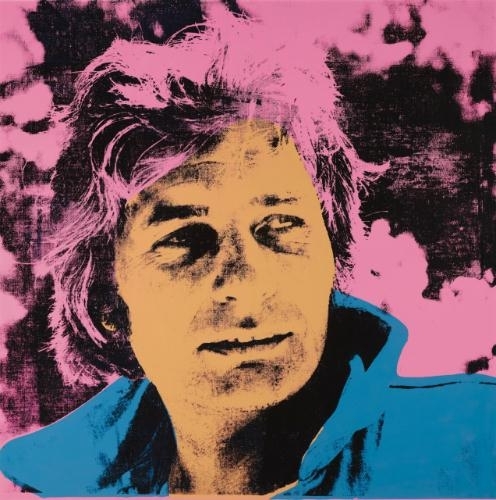
What is often forgotten: Sachs was not just a jet-set decoration. He had taste. Pop Art—before Pop Art became “blue chip.” He had himself portrayed by Andy Warhol; Warhol’s portraits of Sachs were created in 1972 and did not hang in a hallway, but formed the centre of an entire Pop Art living concept in St. Moritz.
He also worked as a photographer and documentary filmmaker—not as a whim, but as serious, publicly presented work. The man could do art as well.
Later, he financed intellectual private projects, including statistical studies on astrology—controversial, yes, but typical: not monetised, driven by curiosity.
And then again, the women—or rather, the one. In 1969 he married the Swedish former model Mirja Larsson, and this marriage lasted until his death—over forty years. St. Moritz became more home than stage: discipline, privacy, routine. Headlines became rarer, good style remained: tailored suits, white shirts, silk, heavy coats. A man with class and a feel for craftsmanship in tailoring—something, in my view, far too rarely respected today.
And if you think he simply died a normal death at some point: no. He chose suicide. In 2011, Sachs took his own life in Switzerland; reports point to his fear of—or conviction of having—Alzheimer’s disease and a desire not to lose control.
This cannot be romanticised, of course. It can only be read for what it was: the final consequence of a man who made conscious decisions and carried them through with clarity.
If you want to be like Mr. Sachs today, then not (only) through money, but through three interests you can measure against yourself—and your lifestyle values—to see whether they suit you:
Glamour & bon vivant lifestyle — He projected a jet-set self-understanding: always dressed just a bit better than necessary, always with a smile. Wherever he went, he set the standard. Can you do that?
Cultural curiosity & sense for art — This should apply to you, without question. If it doesn’t, start reading. Trust me: your interest will grow over time.
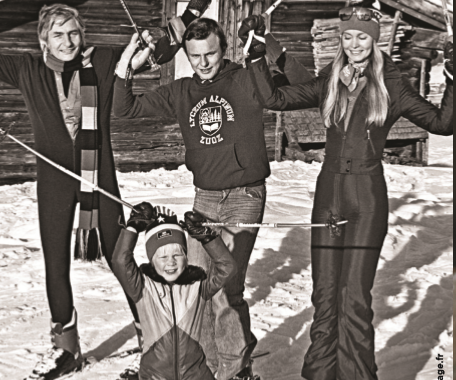
Tradition, discipline & sportsmanship — Alongside Sachs’s glamour stood a need for rules, ritual, performance. Example: his involvement in bobsleigh—not as a hobby, but as belonging to a world where respect is earned, not bought.
The guardrail, if you want to take something from this story: Sachs displayed wealth without begging for belonging. He was generous without theatre. He was loud—but never cheap.
And that is precisely why he remains rare: visibly rich, rigorously well dressed, free in spending—and, in the end, capable of restraint. A jet-setter who could grow old without becoming embarrassing. Very few manage that.
So—let me repeat my opening question: do you want to be like Gunter Sachs?
Sincerely
Flavio
